

Who would have thought that one day, tax news would become outdated within a couple of hours? Yes, you have read the title right. In this piece, we will be trying to decipher the latest hot topic – the U.S.’ reciprocal tariff regime and what we can expect technology-wise.
We will try our best to provide the most updated information. However, we also encourage you to do more research on your own if the topic is of interest to you.
Let’s first get down with the basics.
Read more:What Are the Effects of Global Inflation on the Hospitality Industry?
Understanding the U.S. reciprocal tariff system
On April 2, 2025, the day that U.S. President Donald Trump dubbed “Liberation Day”, is a day to remember – President Trump signed an executive order, unveiled a sweeping tariff regime on more than 180 countries and territories, and fundamentally altered the global trade landscape.
Understanding how this complex system works is essential for businesses navigating its far-reaching implications.
What are reciprocal tariffs?
Reciprocal tariffs represent a tax or trade restriction that one country imposes on another in response to similar actions taken by that country. The U.S. implementation, however, differs significantly from traditional reciprocity. Rather than matching other countries’ exact product-by-product tariff rates, the US system applies country-specific rates calculated through a formula based on trade deficits.
The White House justified these measures by citing the need to “rebalance global trade flows” and address what it considers unfair trade practices that contribute to persistent US trade deficits. President Trump implemented these tariffs via executive order, invoking his authority under the International Emergency Economic Powers Act (IEEPA).
How the U.S. calculates reciprocal tariff rates
The calculation methodology follows a straightforward mathematical formula, despite official descriptions about addressing tariffs, currency manipulation, and trade barriers. The White House determines each country’s rate by:
1. Taking the US goods trade deficit with that country
2. Dividing it by the total US imports from that country
3. Turning that figure into a percentage
4. Dividing the percentage in half
Below is one of the several tariff charts presented by President Donald Trump during his trade announcement on Liberation Day. The chart features two columns, in which the first column serves as the basis for the U.S.’ “discounted reciprocal tariffs” listed in the second column.
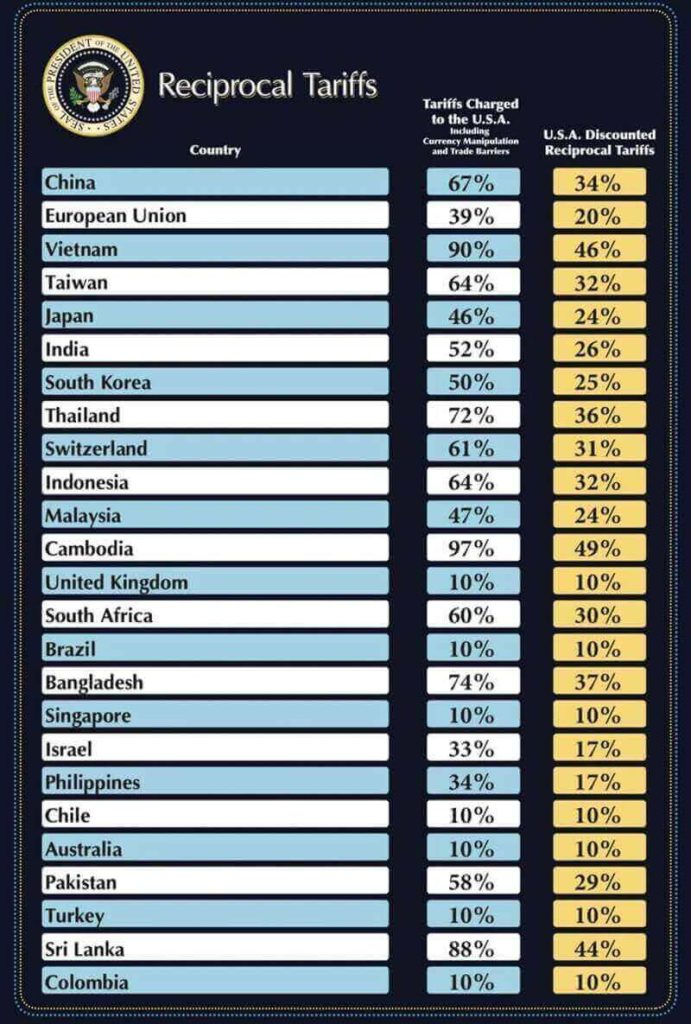
Image credit: CNBC [1]
Many argue that the rates are “bad math on steroids” and no scientific method was behind the calculation [2]. Despite being called “reciprocal”, some nations with small economies still get taxed significantly just because they are in a “trade deficit relationship” with the U.S.
Read more:5 Questions for CIOs Following the Wake of the CrowdStrike Incident
For example, Vietnam’s 46 per cent tariff is a response to the 90 per cent tariff rate on the U.S. exports to the market. The Trump administration claimed that the high rate has “already weighed currency manipulation and trade barriers.” [3]
12% of Vietnam’s economy depends on goods sold to the US. If the US raises tariffs by 46%, Vietnam could lose 5.5% of its GDP [4]. Nevertheless, Cambodia is the one with the highest tariff rates in the Southeast Asia region, 49%. ING’s graph below summarises the rates announced for the entire Asia region.
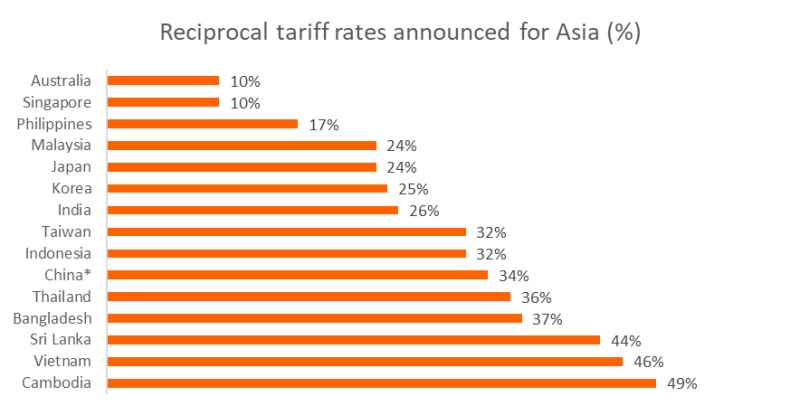
Image credit: ING Global Markets Research [4]
The 10% baseline tariff explained
A baseline 10% ad valorem tariff applies to all imported goods entering the US since 12:01 a.m. EDT on April 5, 2025, with limited exceptions. This baseline represents the minimum rate any country faces, regardless of trade deficit calculations.
The duty adds to any existing tariffs, taxes, fees, or other charges already applicable to imported articles. The administrative exemption from duty (also known as the de minimis exemption; eligible to enter the United States duty-free) remains available for eligible articles valued at US$800 or less until further notice. However, this exemption will soon exclude goods from China and Hong Kong, effective May 2, 2025 [5].
Exemptions and special provisions
Several noteworthy exemptions apply to the new tariff regime:
– Canada and Mexico remain fully exempt as long as existing executive orders stay in place.
– Articles subject to Section 232 tariffs (steel, aluminium, automobiles, auto parts).
– Certain products listed in Annexe II, including pharmaceuticals, semiconductors, copper, lumber, and energy products.
– Column 2 countries (Belarus, Cuba, North Korea, Russia) remain subject to their separate duty rates.
– Articles with at least 20% US-originating content receive partial exemption, with tariffs assessed only on non-US content.
Initially, April 9, 2025, has been set for these country-specific tariff rates to become effective. However, President Trump later announced a 90-day intermission for most countries, except China, which receives an even higher rate of 125% from the initial 104% following China’s retaliatory tariffs against the U.S. announcement.
“Based on the lack of respect that China has shown to the World’s Markets, I am hereby raising the Tariff charged to China by the United States of America to 125%, effective immediately,” Trump shared on Truth Social on April 10. [6]
For global tech supply chains, this means disruptions
Tech giants worldwide are racing to adjust as the new regime disrupts their complex supply networks. The effects ripple through component sourcing, manufacturing costs, delivery schedules and consumer prices, creating immediate challenges for the entire technology ecosystem.
Component sourcing faces great difficulties, and manufacturing costs will undoubtedly increase multifold.
Major technology firms dependent on international suppliers face serious sourcing obstacles. Apple, which produces most iPhones in China, now confronts at least a 145% tariff on these imports [7]. Amazon’s marketplace, heavily reliant on Chinese third-party vendors, must now reconsider its entire approach to product sourcing.
Small companies are not better off. They are feeling more vulnerable than ever. Many manufacturing projects in tariff-affected countries now scramble to evaluate alternatives. These expenses inevitably transfer to product prices, with hardware affected quickly due to “lean inventories and rapid manufacturing cycles”.
Read more:Tips for Managing Small Business Finances & Ensuring Success
The effects reach beyond finished products to their core components. While the White House eventually clarified that semiconductors would be exempt from tariffs, the baseline 10% rate still applies to numerous other tech components.
Nevertheless, the end consumers are the ones who receive the hardest hit in this commotion.
Singapore Prime Minister Lawrence Wong described the turmoil best, “The era of rules-based globalisation and free trade is over! This marks a profound turning point. We are entering a new phase in global affairs; one that is more arbitrary, protectionist, and dangerous… The likelihood of a full-blown global trade war is growing.” [8]
Cloud services and data centre providers are under pressure
Tech experts are expecting fundamental shifts in construction economics, infrastructure costs, and digital transformation timelines, marking the unprecedented pressure across different industries, especially the cloud computing sector:
– Data centre construction costs are projected to increase by approximately 16% as a direct result of the new tariffs [9].
– The 25% tariff on steel imports represents a significant escalation in material costs for new facilities [10].
– Essential components, including steel, lumber, and HVAC systems, face substantial price increases, disrupting project budgets.
Read more:How AWS Manages and Maintains Their Massive Data Centres
This sharp rise stems from China’s position as a major hub for technology manufacturing. Rising material costs combined with limited component availability worsen existing supply chain bottlenecks, potentially delaying launch dates for new facilities.
The effects pour over to digital transformation initiatives, causing businesses to reevaluate and, essentially, tighten IT budgets. The future with the latest technological advancements, like Artificial Intelligence (AI), is, ultimately, frail and gloomy.
Investors are keeping a close eye on how cloud companies reciprocate the tariff situation. Microsoft has previously expressed its intention to invest $80 billion in AI data centres in June. Meanwhile, Amazon is planning to spend over $100 billion, and Alphabet has announced its plans to invest $75 billion in overall capital expenditures this year [11].
Enterprise technology leaders are now speculating if cloud companies might spend more to complete all their planned projects, and if so, whether these extra costs will be passed on to AI users.
How about SaaS solutions and vendors? While they do not deliver physical goods, SaaS providers remain vulnerable to tariff effects. Operational costs might climb, and cloud providers like AWS and Azure might pass on costs through higher hosting fees. Several choose to include tariff escalation clauses allowing annual price adjustments linked to cloud provider fee increases or macroeconomic shifts.
Reshoring and regional tech hubs’ emergence
Beyond immediate business adaptations, the US reciprocal tariff system is triggering fundamental realignments in how and where technology is developed and manufactured globally.
The policy’s intended effect of reshoring all manufacturing sub-verticals has begun taking shape. The White House explicitly identified technology products among sectors where maintaining resilient domestic manufacturing capacity is critical to U.S. national security. This approach aims to recover some of the approximately 5 million manufacturing jobs lost between 1997 and 2024 [12].
A more distributed manufacturing landscape is developing alongside reshoring efforts.
Under the Biden-Harris Administration, the U.S. Department of Commerce’s Economic Development Administration (EDA) announced in January 2025 its plan to award US$210 million to various Tech Hubs across the country, bringing the total to more than US$700 million for 18 centres from 2024 until now [13]. The focus is on jobs and industries of the future.
On the international front, Vietnam has become a manufacturing centre with Apple, Google and Samsung expanding operations there, despite facing a 46% tariff. India increasingly positions itself as China’s alternative for smartphone and semiconductor production, while Mexico gains from nearshoring as US firms move factories closer to home.
Final words
The sweeping US tariffs create a fundamental shift in global technology manufacturing and trade. Despite semiconductor exemptions, the broader tech sector now confronts significant challenges through increased costs, disrupted supply chains, and manufacturing relocations.
Data centre operators face tough choices balancing rising construction expenses against pressing expansion requirements. AI infrastructure projects risk delays as businesses adjust to new cost structures and sourcing requirements.
However, Google Cloud CEO Thomas Kurian appeared confident when asked to comment on the topic at the recent annual Google Cloud Next conference in Las Vegas. “Obviously, we have an executive leadership team that has worked globally for many, many years. We run a global supply chain. We run a global distribution network. And we have been through many cycles like this, whether it’s 2001, 2008, or when the COVID crisis happened in 2020.” [14]
Kurian also emphasised the importance of developing long-term strategies that take these economic and political uncertainties into consideration.
Our team at TRG International is also monitoring the event closely. How about your business? Are you prepared for more “unusual normalcy” to come?

Sources:
1. https://www.cnbc.com/2025/04/02/trump-reciprocal-tariffs-countries-chart-imports-united-states.html
2. https://www.aljazeera.com/news/liveblog/2025/4/9/trump-tariffs-stocks-dive-as-world-braces-for-duties-to-begin-at-midnight
3. https://www.vietnam-briefing.com/news/understanding-the-us-tariff-list-implications-for-vietnam.html/
4. https://think.ing.com/snaps/apac-hit-by-tariffs-in-the-range-of-10-49/
5. https://www.hklaw.com/en/insights/publications/2025/04/president-trump-announces-10-percent-global-tariff-11-percent
6. https://truthsocial.com/@realDonaldTrump/posts/114309144289505174
7. https://edition.cnn.com/2025/04/10/tech/apple-iphone-prices-tariffs-china/index.html
8. https://www.capacitymedia.com/article/trumps-tariffs-threaten-to-upend-the-data-centre-boom-with-rising-costs
9. https://edition.cnn.com/2025/03/12/economy/trump-steel-aluminum-tariffs-hnk-intl/index.html
10. https://www.wsj.com/articles/with-trump-tariffs-even-ai-could-get-more-expensive-83a8f06e
11. https://www.whitehouse.gov/fact-sheets/2025/04/fact-sheet-president-donald-j-trump-declares-national-emergency-to-increase-our-competitive-edge-protect-our-sovereignty-and-strengthen-our-national-and-economic-security/
12. https://www.eda.gov/news/press-release/2025/01/14/biden-harris-administration-awards-additional-210-million-tech-hub
13. https://diginomica.com/google-cloud-next-25-ceo-thomas-kurian-addresses-trump-tariff-uncertainty-and-reassures-eu
14. https://www.youtube.com/watch?v=c5GMKzJVQJM