


The financial services industry in the post-crisis era is still rife with challenges, both old and new, including extensive regulatory changes, technology disruptions, and a greater demand for trust and transparency. Financial services firms operating in such a contested environment need an accounting software solution that can deliver top-notch industry-specific capabilities.
So, how does accounting software cater to the financial services industry look like? What should be included in the ‘must-have’ features and capabilities list?
Read more: Third-Party Risk Accounts for 59% of Insurance Data Breaches. Why?
6 must-have features of accounting software for financial services
1. Global capabilities
As the financial services market is one of the most globalised industries in the world, the right accounting software needs robust multiple-language, multi-entity, and multi-currency capabilities.
The software needs to capture information from different business locations, records, and transactions in multiple currencies, all from a single login. Class-leading software like Infor SunSystems allows for up to 5 reporting currencies per transaction.
Besides, how easily finance professionals can collaborate with each other and with other departments across multiple locations is also a critical aspect to consider. In the financial sector, you cannot afford to let internal communications get lost in translation.
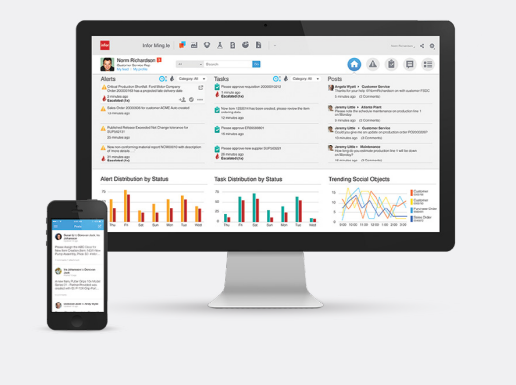
Social collaboration tools such as SunSystems’ Ming.le use mechanisms similar to those of social networks, like chatting, tagging, and commenting, allowing employees to work more effectively by combining social communication with business processes.
Read more:Scaling Innovation and Security with Infor SunSystems Cloud
2. Fast consolidations
The traditional financial close process typically takes weeks to complete, which, in today’s time, is deemed insufficient. A split second can make or break a deal.
Financial managers should be able to obtain high-quality insights in a timely manner, leveraging advanced deep analytics capabilities, to make informed decisions that can potentially have the greatest impact on their organisations.
Therefore, financial services organisations should seek accounting software that accelerates consolidation while maintaining the integrity and credibility of the data. At the same time, the software should help businesses maximise performance, efficiently manage multiple entities, multiple currencies, and asset types, and meet changing compliance requirements with ease.
Read more:Future of Financial Consolidation: Faster, Clearer, Connected
3. Dashboards for multiple devices
Dashboards are an essential part of any financial services firm. Financial professionals need to be able to grasp critical insights – statistics, KPIs, charts, graphs, reports, etc. – at a glance, in real-time, and on the go.
The ability to acquire real-time, relevant information at the fingertips allows finance teams to address issues, respond quickly to changes, and act on new opportunities immediately.
Financial institutions should look for accounting software that enables them to create multiple dashboards to meet their needs and set permissions.
Furthermore, the software should allow you to limit dashboard access and to drill down transactions to specific levels, such as by employee level or department, or to make them open to everyone across the organisation to view.
For example, branch managers, finance team members, and external CPAs all have different data needs; their responsibilities undoubtedly also vary, so each of their dashboards must be tailored specifically to their roles.
4. Integration capabilities
For a financial services firm, seamless integration between back-office and front-end systems (asset management, banking, insurance, trading) is critical to the speed and accuracy of transactions. When data can easily flow in and out of your accounting system, your firm is poised to deliver better returns to clients in any volatile market.
Additionally, integration capabilities are crucial for reporting and analytics. As financial data is stored in different formats and systems across the organisation, the accounting software needs strong integration capabilities to pull data from multiple sources, prepare and analyse it, and transform it into actionable insights.
Why waste time going through the hassle of converting documents into an Excel file and combining everything manually when there is software that can automatically do the task for you?

5. Multi-dimensional and real-time reporting
Traditionally, data used for reporting is pulled from different sources and compiled in a spreadsheet. This manual approach has a downside: it breaks the underlying data connection, leading to invalid analysis if any modifications are made.
To ensure data credibility, firms need to conduct additional manual reconciliation controls. But this step is often bypassed, which raises doubts about the reliability of the information.
Also, because a typical reporting process requires buy-in from multiple departments, the information often becomes outdated and irrelevant before managers and shareholders can even review the financial statements.
Furthermore, financial professionals must repeatedly update reports for each passing period, which consumes significant resources and leads to inconsistencies.
Read more: The Use of Spreadsheets and Modern Cloud Adoption in Businesses
Suitable accounting software will streamline the financial services organisations’ processes, including month-end close, consolidation, management, and financial reporting, thereby helping the firms to improve not only productivity but also help them to reduce costs.
The accounting software should also allow financial firms to generate and customise ad hoc reports with specific capabilities.
6. Regulatory compliance
As the financial services industry is heavily regulated, the accounting software must stay compliant with the latest standards and regulations.
Infor SunSystems complies with multi-GAAP, IAS, and IFRS, which ensures organisations stay on top of any legislation change, always act in accordance with the industry standards and local and international accounting regulations.
Infor SunSystems offers all of the features mentioned above plus the ability to deploy in the cloud, on-premise, or both.
Its intuitive user interface, built-in advanced analytics, and artificial intelligence digital assistant empower users to achieve more, take full advantage of data, and speed up market decisions with compelling analysis and reports.
To witness first-hand the full power of Infor SunSystems and to learn how this modern financial management solution can benefit your organisation, talk to our team of experts by clicking the button below.