


Job interviews are arguably the most beloved tool for employee selection. They are so widely used that interviews are synonymous with the hiring process. However, most job interviews are unstructured, unreliable and ineffective. That is, they fail to predict actual employee performance.
Need help to amp up your recruitment process and, eventually, your talent management strategies? Explore the power of Job Fit & Great People Inside to master how you can match the best people to the perfect roles!

Many studies have shown that there is little relationship between candidates’ performance in interviews and subsequent on-the-job performance.
Most job interviews are unstructured and open-ended. The questions are not standardised, so each candidate may be given a list of questions that are completely different and randomly chosen. More importantly, there are no objective and systematic standards to assess the responses.
An interviewee’s performance is rated solely on the basis of the interviewer’s intuition and personal preferences. Without a doubt, HR professionals love traditional unstructured interviews. They have, however, been scientifically proven to be ineffective for quite some time.
Read more: Unstructured interviews reflect unfairness in hiring
Interviews are terrible at predicting performance
In a groundbreaking meta-analysis (a statistical procedure for combining data from multiple studies) published in the Psychological Bulletin in 1998, Frank Schmidt and the late John Hunter analysed 85 years of prior research on how well different selection methods predict on-the-job performance. Among 19 methods, the commonly used unstructured interview ranked ninth.
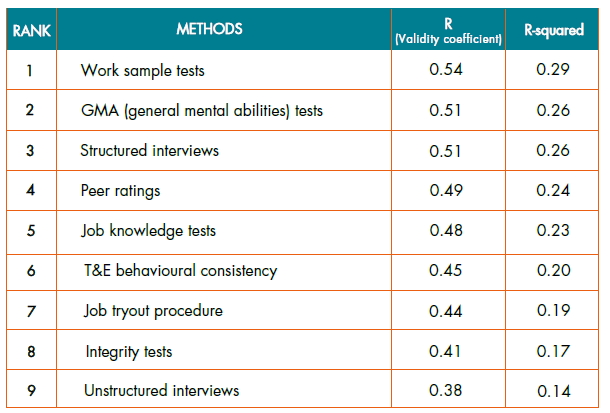
The R-squared value of 0.14 indicates that unstructured job interviews explain only 14% of the variation in hired employees’ actual performance. The higher a method’s R-squared, the greater its predictive power. Consequently, hiring the right people is practically a hit-or-miss proposition if hiring managers rely solely on unstructured interviews.
Unstructured job interviews are unreliable and ineffective because they are influenced by the interviewers’ biased and subjective judgments. Even though HR professionals tend to believe they are good at judging people, they are, in fact, subject to a variety of cognitive biases that hinder their ability to make fair and accurate decisions.
Research has shown that structured interviews and other assessment tools, such as cognitive and personality tests, are superior to traditional unstructured interviews for hiring the right people. Nonetheless, the HR professionals’ resistance to moving away from their much-loved tool means organisations still rely on a selection method that does not work.
This blog is a part of the whitepaper “The Interview Addiction”. Please click the link below to download the full whitepaper.