


The importance of revenue optimisation, or revenue management, in the hotel industry cannot be overstated, as it is critical to the Hotel’s bottom line. Revenue optimisation is about selling the right room to the right guest, at the right price and at the right time. It requires plenty of actionable information on time, which is so often unattainable.
Why your revenue management team needs Analytics
In the absence of a data analytics solution, most revenue optimisation teams would naturally rely on Excel and Access. The problems with this approach are:
- Siloed and out-of-date data: fragmented data is stored in different places, such as spreadsheets that are manually updated weekly or monthly.
- Limited direct access: only a select few can access all the datasets.
- Ad-hoc reports: Reporting is based on simple one-off Excel spreadsheets that require significant resources to update.
Due to those limitations, data analysis is painfully slow. This approach may work, to a certain extent, for one hotel or a small chain of a dozen hotels but is definitely unsustainable for a large chain of hundreds or even thousands of properties.
Read more:From Empty Rooms to Full Profits: How Revenue Management Works
Carlson Rezidor Hotel Group is one of the world’s leading hotel companies with more than 1,300 hotels in nearly 100 countries and territories. Its revenue optimisation team used to rely on Excel and Access for analytics and reporting.
The performance was slow and lacklustre. The team spent half their time pulling and formatting raw data rather than analysing it and making actionable recommendations. Subsequently, the team could only provide analysis 2 or 3 times per year for each hotel in the chain. Even worse, the hotels found their reports and recommendations to be useless.
The company then decided to adopt a Business Intelligence solution and observed almost immediate results. After the first five weeks, they were able to create 75 different dashboards. And in less than three months, the number of hotels requesting weekly reports rose from 0 to 300.
Starwood Hotels and Resorts, which owns, operates and manages nearly 1,300 properties globally, heavily relies on data analytics to optimise room pricing. They even analyse weather data from the US to predict demand for Caribbean trips. The investment in BI is expected to increase their revenue per room by 5 per cent.
Analytics enables hotel chains to make informed decisions based on facts rather than gut feelings and to take bigger, more calculated risks. They would be able to anticipate who is going to book, at what rate, for what length of stay, through which channels, and how much in advance.
Analytics in action
How can analytics actually help revenue managers? The following example using a BI solution will demonstrate the power of analytics in hotel revenue management.
Pricing comparison
The visualisation below helps revenue managers see where their hotels are priced relative to competitors over a 120-day period. It combines the actual rates, the competitors’ rates, and the recommended rates which are based on the projected demand data. Each row represents a hotel, while each column represents one day in the period.
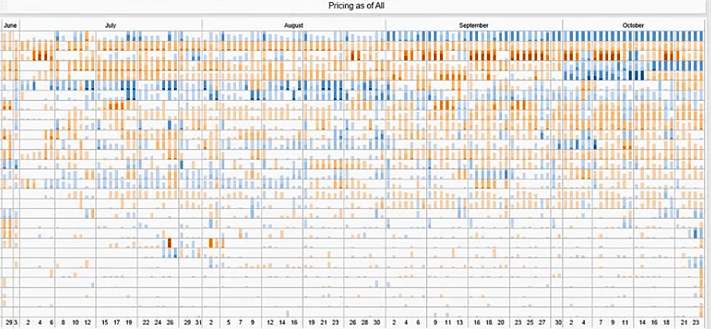
By looking at this visualisation, revenue managers can swiftly identify which dates and which specific hotels are overpriced or underpriced. A blue bar indicates an overpriced date at a given hotel. An orange bar means an under-priced date. The darker the colour, the more overpriced or under-priced the dates are.
Read more:Achieve Higher Resilience With Cloud Hotel Management Solution Infor HMS
When information is visualised this way, revenue managers gain insight at a single glance. For example, the hotel in the first row is consistently overpriced. On the other hand, the hotels in the bottom rows have their rates set very close to the recommended rates because there are very few visible bars.
Without the analytics capabilities of a Business Intelligence solution, the revenue managers would have to spend a huge amount of time looking at each hotel individually. And, for each hotel, they would have to go through every single date to identify issues (overpriced dates) or opportunities (under-priced dates).
Do you want to know why and how market-leading hotel chains are rapidly transforming digitally? Download our white paper below and find out.